The importance of Food Cost for a Pizzeria:towards a culinary sustainability
It is discussed in the Food Service market in particular, Food Cost presents financial and business opportunities, with also a social and environmental. For a pizza place, this aspect has an even more significant role: the choice of all ingredients and process affects directly the product’s quality and indirectly the environment.
Encouraged also by the growing interest of new generations in environmental issues, the Food Service world is moving with increasing conviction toward the use of natural flours from Italian grains. A quality guarantee and respect for the environment is also Molino Naldoni’s choice to reduce its environmental impact through the use of Italian wheat and the construction of local supply chains.
The culinary sustainability became a crucial topic in the global landscape and pizza places are the main characters of this new social responsibility linked to the food market. A careful attention to the Food Cost means several real and tangible advantages that extend themselves further than to the financial report.
1. Conscious ingredients’ choices: the Food Cost pushes who manages a pizzeria to consider carefully their supply sources. Using ingredients of high quality, local and zero-miles it can not only reduce long-term costs, but also the environmental impact deriving from the transport of food at long distances.
2. Minimise the waste: a careful managing of Food Cost encourages the reduction of food waste and garbage. The pizzerias can analyse the quantities needed for the daily production, limiting the packaging and rationalising the use of resources and waste.
3. Promoting the biodiversity: being careful to the Food Cost allows to innovate the menu easily and to sustain the culinary biodiversity, offering to the clients selected ingredients. This can encourage the use of a variety of wheat and local or seasonal vegetables, contributing to save the richness of the available food resources.
4. Involvement of clients: a pizzeria who committed actively on the Food Cost control can also communicate it and create a deeper relationship with its clients. The consumers are always more sensible to the environmental themes and reward the businesses which demonstrate a real responsibility towards the Earth’s future.
5. Energy savings: the Food Cost can help to optimise the use of culinary resources. The economical managing of ingredients and operations can be translated to a more effective and efficient use.
6. Leadership in the sector: a pizzeria who emphasises the sustainability and the Food Cost can become a reference point in its sector. The positive example of a conscious approach can influence other food businesses and inspire a collective change towards more responsible practices.
Controlling the Food Cost for a pizzeria is a practice that goes behind the financial aspect. Its aware managing is an investment in terms of reputation of the business and quality for the client. Make sustainable decision in choosing the ingredients, in reducing food waste and in the actionable efficiency can transform a pizzeria in an honest example of culinary sustainability.
What’s the right price for a Pizza Margherita?
In order to be pragmatic, we started from an editorial of Ristorazione Italiana and, assisted by our Technical Manager Piero Asaro, we created an example of Food Cost for a take-away Pizza Margherita. The estimated amounts are subject to several variables therefore entirely approximate, calculated on a base of 80 pizzas per day, in 300 working days.
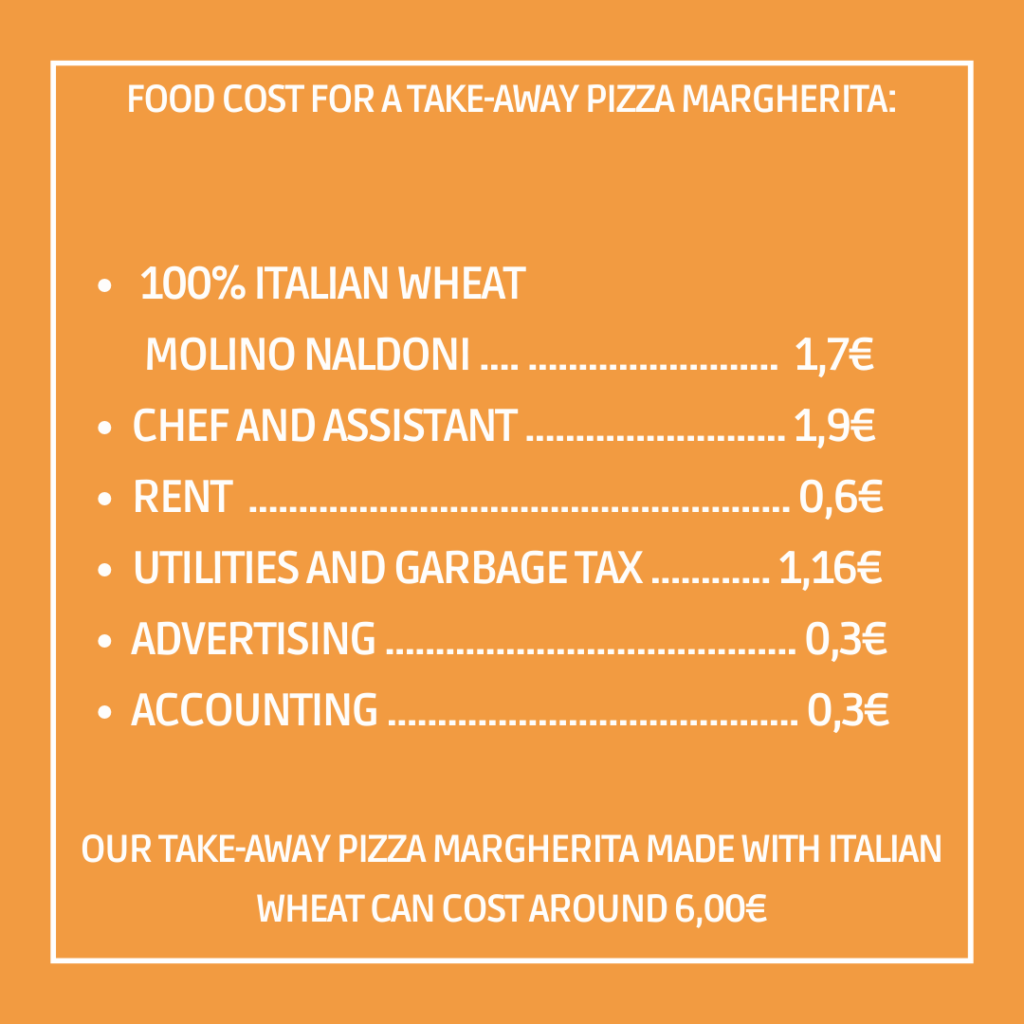
Analysing the different items that compose our price to the public:
– Cost of pizza Margherita 100% Italian wheat … 1,70€
Composed by the dough of about 240 grams for a pizza which has a medium diameter of 33 cm, supposing a medium cost of ingredients for a total of 1,50€ for every pizza margherita. (Approximation of costs using flour ITALICA 1,10€/kg, yeast 5,40€/kg, tomato 1,50/kg, oil and mozzarella cheese 9,00€/lt or €/kg, to which it’s added the cost of water, salt and basil)
– Cost of pizza chef and assistant … 1,90€
orientation at 4* level CCNL (an Italian collective contract for a kind of workers), with an assistant.
– Cost of rent … 0,60€.
With a rent of 1200€ per month.
– Cost of utilities and garbage tax …1,16€
Calculated on monthly bills with total sums of about 2500€
– Cost of accounting and advertising … from 0,40€ to 0,60€ per pizza, for a basic accounting and advertising.
Our take-away pizza Margherita made with Italian wheat can cost around 6,00€.
This cost can be increased if the pizzeria offers a bigger service and needs more workers other than the pizza chef and assistant (e.g. waiters).
In this case, to the above-mentioned cost of 6€ it needs to be added the annual cost that the pizzeria needs to pay for the other workers, divided by the total number of pizzas sold in a year. In the hypothesis that the pizza place has a waiter who costs 36.000€ (salary+IRPEF+INPS+TRF part) and the business sells 2000 pizzas per month, so 24.000 per year, we should add: 36.000€/24.000 pizzas = 1,5€ per pizza.
The pizza Margherita from Italian wheat will cost a total of 6€ + 1,5€ = 7,5€.